
Early Cenozoic Climate Reconstruction
Using deep-sea sediments recovered through the International Ocean Discovery Program (IODP), we generate proxy records of past changes in Earth’s oceans and climate, in particular the stable oxygen and carbon isotopic composition of marine carbonates.
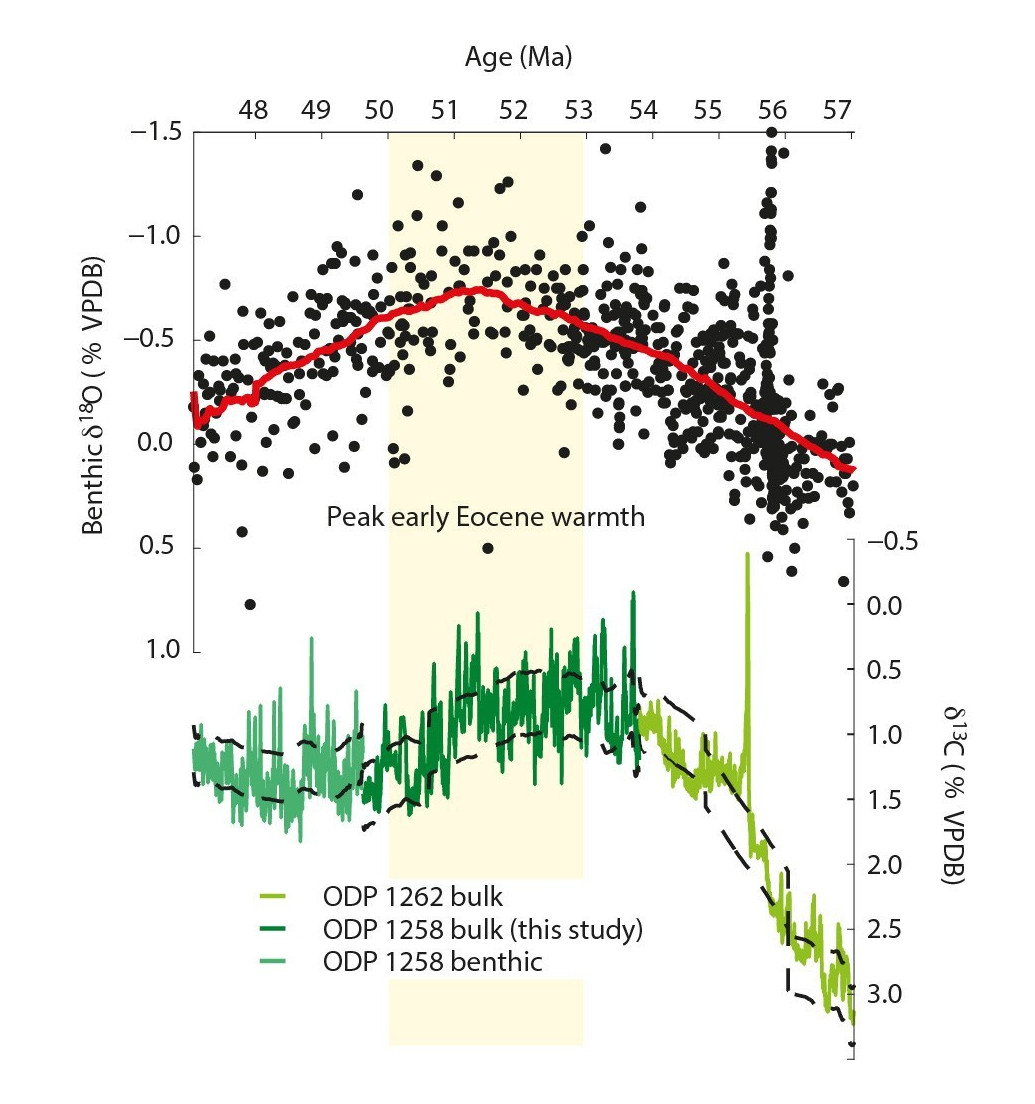
(top) Benthic foraminiferal oxygen isotope records and (bottom) High-resolution carbon isotope records across the Early Eocene Climate Optimum (57-47 Ma) revealing a dynamic carbon cycle during times of extreme global warmth (see Kirtland Turner et al., 2014).
Modeling of Past Climates
We use the intermediate complexity Earth system model cGENIE to reconstruct and evaluate past carbon cycle and climate processes.
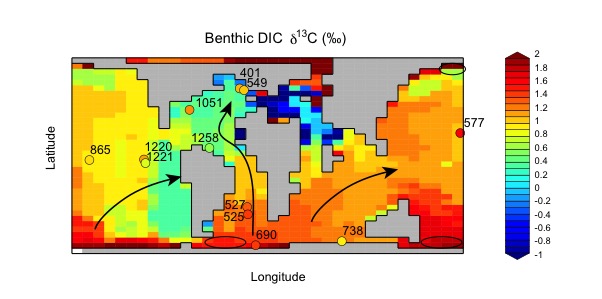
Model output of the carbon isotopic composition of the deep sea in the cGENIE Earth system model compared to benthic foraminiferal carbon isotope data (in circles). Arrows indicate pathways of past deep water circulation (see Kirtland Turner and Ridgwell, 2013).
Past Analogs for Future Climate Change
We reconstruct and model abrupt warming events in the early Cenozoic, called hyperthermals, associated with carbon release to the atmosphere and oceans.
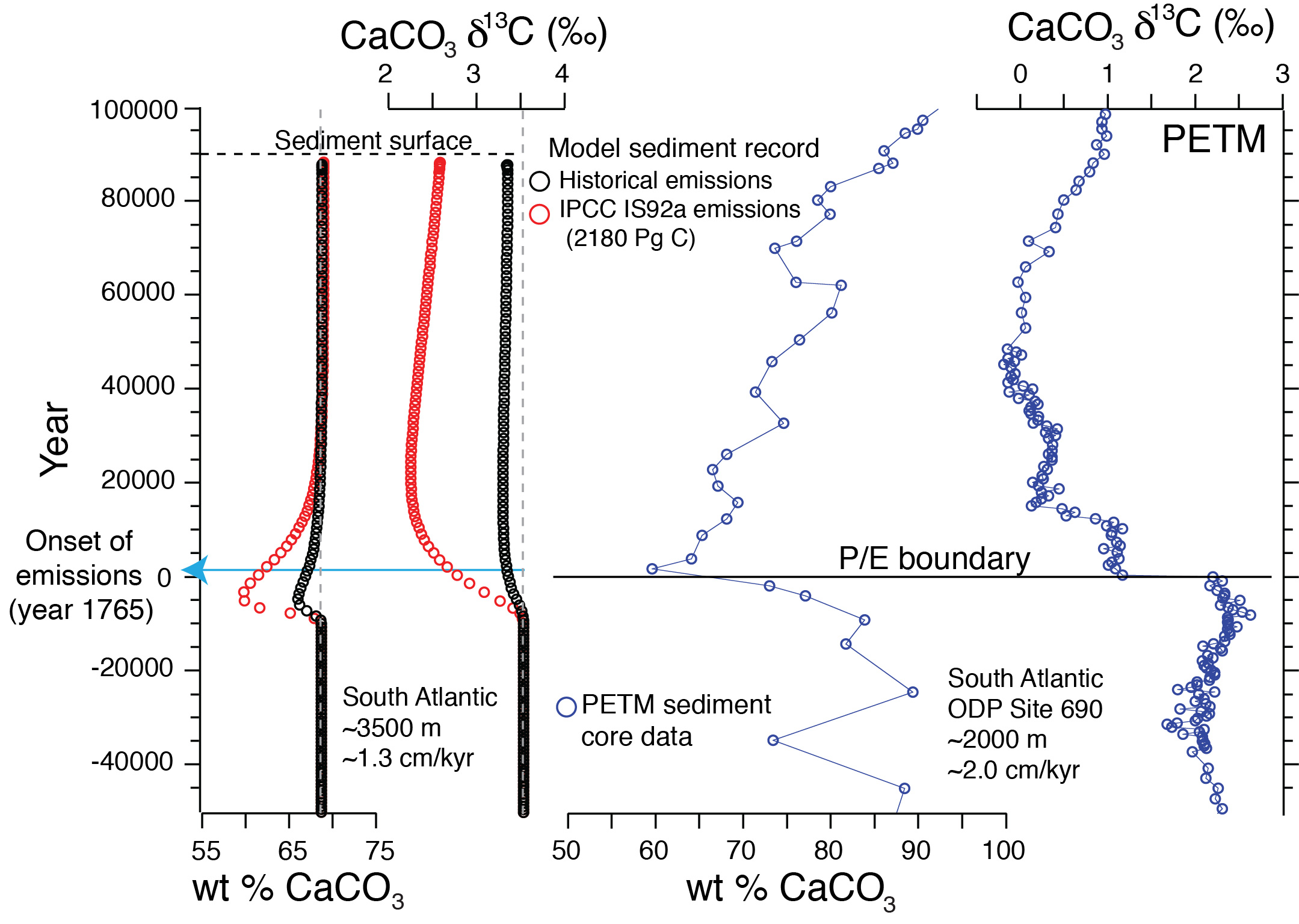
(left) Model results for what historical (black lines) and modern (red lines) carbon emissions would look like preserved as a record in deep sea sediments and (right) deep sea sediment record of the Paleocene-Eocene Thermal Maximum, a prominent hyperthermal event that occurred about 56 million years ago (see Norris et al., 2013).
 Kirtland Turner Lab